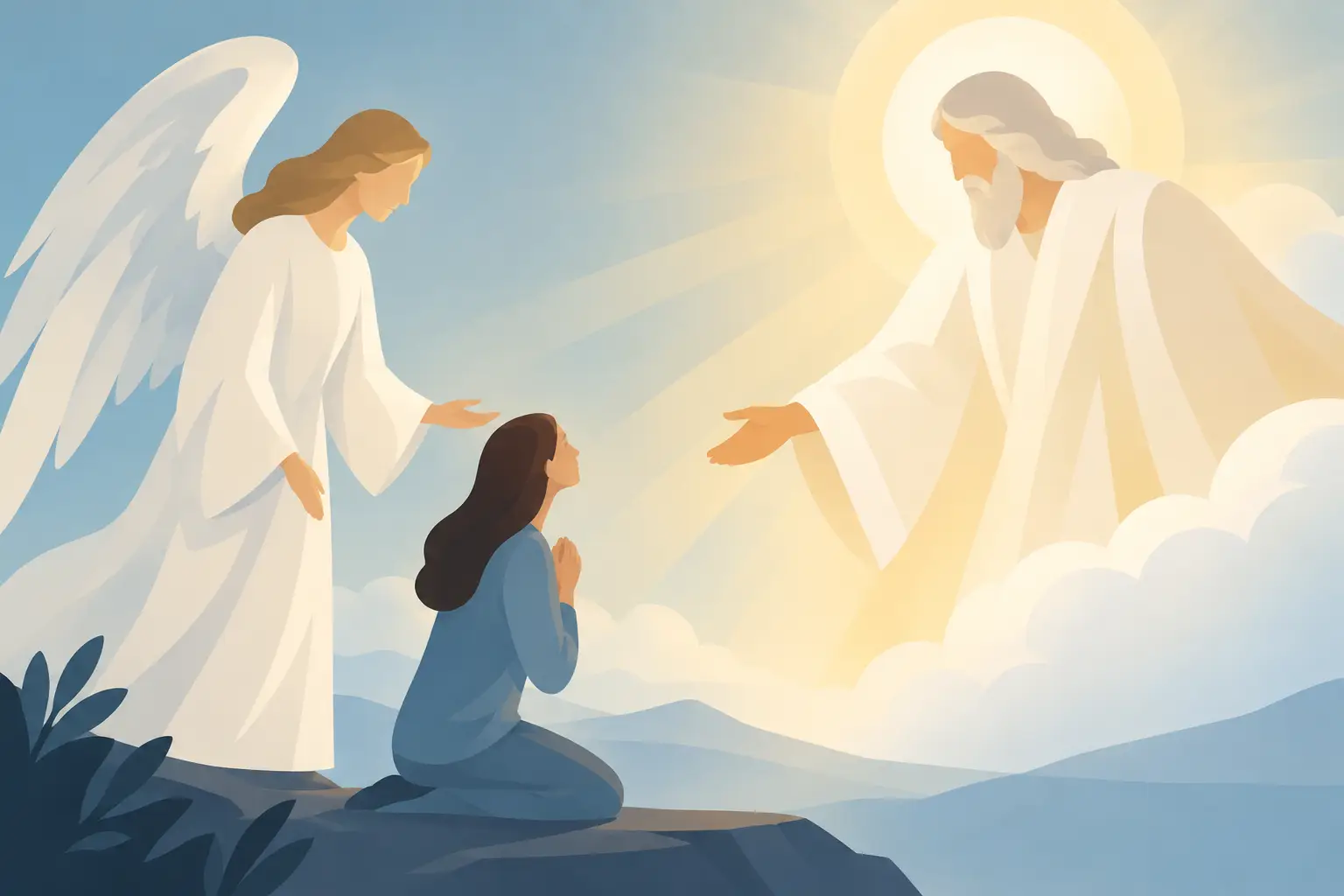
A vision can arrive without warning: in the silence after loss, in a moment of danger, or in the long night when a person has no strength left to pretend they are unafraid. When people speak of angel and God, they are often not describing an abstract religious idea. They are trying to name an encounter with mercy, warning, protection, or a call that changed the direction of their lives.
For a refugee, a survivor, a parent carrying grief, or anyone rebuilding after a season of darkness, the question is rarely academic. Why was I spared? Who was with me when no human hand could reach me? What am I meant to do with the life I have been given?
Angel and God in the Language of Faith
Across faith traditions, angels appear as messengers, servants of the Holy, protectors, witnesses, and bearers of difficult truth. They do not ask to be worshiped. Their presence points beyond themselves, toward God, toward responsibility, and toward a reality larger than fear.
This distinction matters. An angelic encounter, whether understood literally, symbolically, or somewhere in the mysterious space between, is not meant to make a person feel spiritually superior. In the sacred stories that have endured across centuries, people often respond to an angel first with trembling. The message may bring comfort, but it can also bring a command: go forward, tell the truth, protect the vulnerable, forgive, or carry peace into a divided world.
God is not reduced to a sign, a vision, or a voice in a single moment. God remains beyond human control and beyond every narrow category we build. Yet many people testify that, during their greatest trials, divine love became more real to them than comfort ever had. The experience did not erase suffering. It gave suffering a horizon beyond despair.
Why Sacred Encounters Often Begin With Fear
The first words spoken by heavenly messengers in sacred tradition are often some form of “Do not be afraid.” That phrase does not deny danger. It recognizes it. Fear is real when a family is separated, when war destroys a homeland, when hunger follows displacement, or when trauma continues long after a person has reached physical safety.
For those who have lived through war and exile, faith can be tested in ways that others may struggle to understand. It can feel too simple when someone says that everything happens for a reason. Not every wound receives an answer that satisfies the mind. Not every prayer is answered in the timing we want. A compassionate faith makes room for tears, questions, and even anger.
Still, many survivors carry a testimony that cannot be dismissed: something held them together when every visible support was gone. Some call it God. Some describe an angelic protection. Some recognize a presence through prayer, dreams, ancestors, or a sudden conviction that they must keep going. The language differs, but the fruit of the encounter deserves attention. Does it lead a person toward compassion, courage, humility, and peace? Or does it feed isolation, pride, and fear of others?
That question is a form of spiritual discernment.
A message is measured by its fruit
Not every powerful feeling is a divine message. Human beings are vulnerable in times of loss, and the desire for certainty can be intense. Faith does not require abandoning wisdom. It asks us to hold extraordinary experiences with reverence and humility.
A message that comes from God will not demand cruelty in the name of holiness. It will not make hatred sacred. It will not excuse the suffering of another people because they pray differently, speak another language, or carry another history. A calling may be demanding, but its deepest direction is toward truth joined with love.
This is especially vital in an age when spiritual language is sometimes used to divide. The world does not need more people claiming private revelation as a weapon. It needs people whose faith makes them more honest, more merciful, and more willing to serve the one human family.
When an Angel Brings a Calling, Not an Escape
There is a temptation to think of angels only as rescuers who remove hardship. But many sacred accounts tell a more challenging story. The messenger appears, the person is strengthened, and then the person must continue the journey. The danger may not vanish. The responsibility may become clearer.
A survivor who has crossed an ocean may spend decades learning how to live with memory. A child of refugees may inherit stories of sacrifice alongside silence that is difficult to break. A person who receives a vision may feel comforted, but also burdened by the knowledge that their life is meant for more than private survival.
This is where faith becomes active. Gratitude for protection can become service. Grief can become a witness for peace. A life saved can become a life offered in defense of human dignity.
The calling will look different for each person. One individual may be called to raise children with tenderness after growing up in violence. Another may speak publicly about a forgotten history. Another may pray faithfully in secret, visit the lonely, or refuse to pass hatred to the next generation. There is no small act when it is rooted in sincere love.
An Interfaith Vision of Light and Peace
The mystery of angels and God is not confined to one people or one vocabulary. Christianity speaks of angels as God’s messengers. Islam honors angels and recognizes their obedience to God’s will. Buddhism offers rich teachings on compassion, awakening, and the unseen dimensions of moral life. Indigenous spiritual traditions often preserve a profound awareness of creation, ancestry, sacred responsibility, and the interdependence of all life.
These traditions are not identical, and treating them as if they are would erase their depth. Their differences deserve respect. Yet people of many backgrounds recognize a shared moral truth: life is sacred, suffering calls for compassion, and human beings are accountable for how they treat one another.
An interfaith approach is not a request to water down conviction. It is an invitation to seek peace without surrendering what is holy. A Christian can pray in the name of Christ while honoring the sincere prayer of a Muslim neighbor. A Vietnamese family can carry Buddhist and Christian influences through generations while remaining honest about the complexity of its story. A person can believe deeply in divine revelation without assuming that God’s mercy has stopped at the border of their own community.
When light is real, it does not fear another lamp.
Living With Reverence After the Vision
Some people will never describe a dramatic supernatural encounter. That does not mean God is absent from their lives. Divine guidance may come through a grandmother’s prayer, a stranger’s timely kindness, a dream that restores courage, a line of scripture remembered in crisis, or the quiet strength to choose forgiveness one more time.
The goal is not to chase signs. Chasing signs can leave a person restless and vulnerable to disappointment. The deeper work is to become attentive: to pray, to reflect, to test what one receives against love and truth, and to remain accountable to wise and compassionate people.
Those who believe they have encountered an angel or received a message from God may also need patience. Not every revelation is meant for immediate action. Time can clarify what emotion alone cannot. Prayer, trusted counsel, study, and service can reveal whether an experience is producing genuine spiritual maturity.
For those who carry trauma, professional care can also be part of faithfulness. Seeking support for anxiety, grief, or painful memories does not deny spiritual experience. It honors the whole person – body, mind, memory, and soul. God’s care can arrive through prayer, community, medicine, counseling, and the patient work of healing.
The sacred question is not only, “Did I see an angel?” It is also, “Who am I becoming because I believe God met me in the darkness?” Let the answer be found in a softer heart, a braver voice, and a peace that makes room for others.
Leave a Reply